axon : A long, membrane-bound extension of the cell body that passes the nerve impulse onto the next cell.
brain stem : Part of the brain involved with unconscious (autonomic) functions such as breathing, heartbeat, and temperature regulation
cell body : Part of a neuron that contains the nucleus and other organelles.
cerebellum : The part of the brain that is involved in coordination and control of body movement.
cerebral cortex :The highly-folded outer layer of the cerebrum; controls higher functions, such as consciousness, reasoning, emotions, and language.
cerebrum : The part of the brain that generally controls conscious functions such as problem-solving and speech.
central nervous system (CNS) : Made up of the brain and spinal cord; .
dendrites : Extend from the cell body and receive a nerve impulse from another cell.
interneurons : Neurons that connect sensory and motor neurons in neural pathways that go through the CNS; also called association or relay neurons.
motor neuron : Neuron that carries nerve impulses from the central nervous system to internal organs, glands, or muscles.
myelin sheath : An electrically insulating layer; covers the axon; speeds up the transmission of a nerve impulse along the axon.
nerve : An enclosed, cable-like bundle of axons.
nerve impulse : Electrical signal that is transmitted by neurons.
nervous system : Body system that controls all the other systems of the body.
neuron : The structural unit of the nervous system. This cell transmits electrical signals.
neurotransmitter : Chemical messages which are released at the synapse and pass the “message” onto the next neuron or other type of cell.
peripheral nervous system (PNS) : All the nerves of the body that lie outside the central nervous system.
sensory neurons : Neurons that carry signals from tissues and organs to the central nervous system; sometimes called afferent neurons.
spinal cord : A thin, tubular bundle of nervous tissue that extends from the medulla oblongata (brain stem) and continues to the lower back
synapse : A specialized junction at which the axon of one neuron comunicate with dendrite of another neuron.
lunes, 4 de abril de 2011


domingo, 27 de marzo de 2011
Extra resources
As in the last unit you can take a look to the H.E.A.D. (Health Educational And Training). Videos. First you have one video about nervous system and next another one about the endocrine system.
Here you have a link to an interesting brain atlas of Lundbeck Institute.
Here you have a link to an interesting brain atlas of Lundbeck Institute.
Voluntary and involuntary actions
There are two main kinds of actions that our body carries out:
Voluntary Actions:
A voluntary action is basically an action which you yourself initiate by your own conscious. Your cerebral cortex (brain) sends impulses from it to the effectors (muscles or glands) via the spinal cord with relay neurons and finally a motor neurons. This action is under the control of the will thus is known as a voluntary action.
Involuntary Actions (Reflex Actions):
Involuntary actions as their name suggest, are total opposites of voluntary actions, a reflex action is not under the control of the will. In this case, your spinal cord takes total control, without your own conscious. Reflex actions controlled by the spinal cord, example scratching, are called spinal reflexes. There are also cranial reflexes, example blinking, that are controled by de brain but not by the cerebral cortex. Brushing, sneezing and salivation are also reflex actions however, salivation is also known an conditioned reflex action which we will be discussing later. In this webpage Kidshealth you can read and listen to a explanation of different reflex actions.
This table compares the two types of actions:
- Voluntary actions,
- Involuntary actions or reflex actions.
Voluntary Actions:
A voluntary action is basically an action which you yourself initiate by your own conscious. Your cerebral cortex (brain) sends impulses from it to the effectors (muscles or glands) via the spinal cord with relay neurons and finally a motor neurons. This action is under the control of the will thus is known as a voluntary action.
Involuntary Actions (Reflex Actions):
Involuntary actions as their name suggest, are total opposites of voluntary actions, a reflex action is not under the control of the will. In this case, your spinal cord takes total control, without your own conscious. Reflex actions controlled by the spinal cord, example scratching, are called spinal reflexes. There are also cranial reflexes, example blinking, that are controled by de brain but not by the cerebral cortex. Brushing, sneezing and salivation are also reflex actions however, salivation is also known an conditioned reflex action which we will be discussing later. In this webpage Kidshealth you can read and listen to a explanation of different reflex actions.
This table compares the two types of actions:
| Voluntary actions | Reflex actions |
| Iniated in cerebral cortex of brain - due to though | Iniated by stimulation of receptor |
| Impulses passes from the motor area in cerebral cortes down spinal cord to: | Impules pases sensory neuorns and relay neurone in grey matter of spinal cord which passes impulse to: |
| Motor neurone carries impulse to effector (muscle) with contracts and produces action | Motor neurone carries impulse to effector (muscle) with contracts and produces action |
| Impulses passes over to oppsite side of the body | Stimulus, neurones, actions all on same side of body |
| Many cells and synapses, and longer pathway – therefore slow. | Only 3 cells, 2 synapses – therefore quicker. Secondary information passes up spinal cord to brain, so subject is aware after event. |
In a reflex actions a receptor pick up the stimulus. Impulses are produced and travel along the sensory neurons to the spinal cord.. The reflex actions are very rapid and they are designed to prevent injury. So they are automatic, you do not have to think about them.

In a reflex action a sensory receptor is stimulated by a stimulus, signals pass from it along a sensory neuron ( afferent neuron) to the spinal cord. The impulse passes through a relay neuron, directly to the motor neuron (efferent neuron) that transmites the impulse to the effector (e.g., a muscle or a gland), which acts accordingly. Such a pathway is called a reflex arc.
Conditioned Reflex:This videos is another way of learn it.
A conditioned reflex action is a special kind of reflex action which results from the learning from past experiences. For example, many people salivate at the smell of good food as they had learnt from past experiences that such smell are associated with good food and they have to urge to want to eat them, hence salivary glands are stimulated and saliva is produced and secreted.
viernes, 25 de marzo de 2011
Peripheral Nervous System (P.N.S)
The peripheral nervous system (PNS) consists of all the nerves and ganglia outside the central nervous system (a ganglion is a mass of nerve cell bodies). They include nerves of external and internal organs. The PNS connects the CNS with all the parts of the body.
The peripheral nervous system is divided into two parts: the sensory division and the motor division. How these divisions of the peripheral nervous system are related to the rest of the nervous system is shown in Figure. Refer to the figure as you read more about the peripheral nervous system below.

The sensory division carries messages from sense organs and internal organs to the central nervous system. Human beings have several senses. They include sight, hearing, balance, touch, taste, and smell. We have special sense organs for each of these senses. Sensory neurons in each sense organ detect a certain type of stimulus, or input. For example, sensory neurons in the eyes detect light, and sensory neurons in the skin detect touch.
Our sense organs detect sensations, but they don’t tell us what we are sensing. That’s your brain’s job. The sense organs send messages about sights, smells, and other stimuli to the brain. The brain then interprets the messages. A particular area of the brain interprets information from each sense organ. For example, information from the nose is interpreted by the temporal lobe of the cerebrum.
The motor division of the peripheral system carries messages from the central nervous system to internal organs and muscles. As shown in Figure, the motor division is also divided into two parts:
The somatic nervous system
The autonomic nervous system.
The somatic nervous system carries messages that control the muscles and so the body movements.
The autonomic nervous system carries nerve impulses to internal organs. It is responsible for activities that are not under your control, such as sweating and digesting food. The autonomic nervous system has two divisions:
The sympathetic division of the autonomic nervous system is the division that prepares the body for stressful situations. It is often referred to as the "fight or flight" system. The effects of this system are numerous, but generally include increasing heart rate, constricting blood vessels to the skin and viscera (thereby increasing blood flow to muscles), increasing pupil size and decreasing salivation. These responses all promote survival in a dangerous situation.
The parasympathetic division of the autonomic nervous system prepares the body for restful situations and is often called the "rest and digest" system. Effects of the parasympathetic nervous system include slowing heart rate, increasing gastric motility, and increasing salivation. These responses help the body to recover as well as prepare for stressful situations by storing nutrients.
In this link you can find how acts each division.
The peripheral nervous system is divided into two parts: the sensory division and the motor division. How these divisions of the peripheral nervous system are related to the rest of the nervous system is shown in Figure. Refer to the figure as you read more about the peripheral nervous system below.

The sensory division carries messages from sense organs and internal organs to the central nervous system. Human beings have several senses. They include sight, hearing, balance, touch, taste, and smell. We have special sense organs for each of these senses. Sensory neurons in each sense organ detect a certain type of stimulus, or input. For example, sensory neurons in the eyes detect light, and sensory neurons in the skin detect touch.
Our sense organs detect sensations, but they don’t tell us what we are sensing. That’s your brain’s job. The sense organs send messages about sights, smells, and other stimuli to the brain. The brain then interprets the messages. A particular area of the brain interprets information from each sense organ. For example, information from the nose is interpreted by the temporal lobe of the cerebrum.
The motor division of the peripheral system carries messages from the central nervous system to internal organs and muscles. As shown in Figure, the motor division is also divided into two parts:
The somatic nervous system
The autonomic nervous system.
The somatic nervous system carries messages that control the muscles and so the body movements.
The autonomic nervous system carries nerve impulses to internal organs. It is responsible for activities that are not under your control, such as sweating and digesting food. The autonomic nervous system has two divisions:
The sympathetic division of the autonomic nervous system is the division that prepares the body for stressful situations. It is often referred to as the "fight or flight" system. The effects of this system are numerous, but generally include increasing heart rate, constricting blood vessels to the skin and viscera (thereby increasing blood flow to muscles), increasing pupil size and decreasing salivation. These responses all promote survival in a dangerous situation.
The parasympathetic division of the autonomic nervous system prepares the body for restful situations and is often called the "rest and digest" system. Effects of the parasympathetic nervous system include slowing heart rate, increasing gastric motility, and increasing salivation. These responses help the body to recover as well as prepare for stressful situations by storing nutrients.
In this link you can find how acts each division.

Cerebrum
First at all, if you want, in this link you can find a brief overview of the nervous system. The teacher in the video speak very slowly and it's easy to understand but, maybe, too much information for 3º E.S.O.
In this post we are going to study the cerebrum. As it have a los of difficult names maybe this funny video can help you to remember them.
 The cerebrum is what most people would think of as the "brain." Mammals (including humans), have the largest and most well-developed cerebrum among all species.
The cerebrum lies on top of the brainstem. It’s divided into a right and left half. Each half of the cerebrum is called a hemisphere. Each of these hemispheres has an outer layer of grey matter (body cells of neurons) called the cerebral cortex that is supported by an inner layer of white matter (myelinated axons). The two cerebral hemispheres are connected to each other at the corpus callosum. It lies deep inside the brain and carries messages back and forth between the two hemispheres. The right hemisphere controls the left side of the body, and the left hemisphere controls the right side of the body.
The cerebral cortex is the highly-folded outer layer of the cerebrum that is between 2 mm and 4 mm thick. The lobes that make up the cerebral cortex, shown in Figure, are named after the skull bones that cover those areas of the brain. Each hemisphere of the cerebrum is divided into four parts called lobes. The four lobes are the frontal, parietal, temporal, and occipital lobes. Each lobe has different functions. Some of the functions are listed in Table:
Cerebral Lobes and Their Functions
The cerebral cortex controls higher functions, such as consciousness, reasoning, emotions, and language. It also controls sensory functions such as touch, taste, smell, and responses to external stimuli.
Magnetic resonance imaging
In this post we are going to study the cerebrum. As it have a los of difficult names maybe this funny video can help you to remember them.
 The cerebrum is what most people would think of as the "brain." Mammals (including humans), have the largest and most well-developed cerebrum among all species.
The cerebrum lies on top of the brainstem. It’s divided into a right and left half. Each half of the cerebrum is called a hemisphere. Each of these hemispheres has an outer layer of grey matter (body cells of neurons) called the cerebral cortex that is supported by an inner layer of white matter (myelinated axons). The two cerebral hemispheres are connected to each other at the corpus callosum. It lies deep inside the brain and carries messages back and forth between the two hemispheres. The right hemisphere controls the left side of the body, and the left hemisphere controls the right side of the body.

The cerebral cortex is the highly-folded outer layer of the cerebrum that is between 2 mm and 4 mm thick. The lobes that make up the cerebral cortex, shown in Figure, are named after the skull bones that cover those areas of the brain. Each hemisphere of the cerebrum is divided into four parts called lobes. The four lobes are the frontal, parietal, temporal, and occipital lobes. Each lobe has different functions. Some of the functions are listed in Table:
Cerebral Lobes and Their Functions
| Lobe | Main Function(s) |
| Frontal | Speech, thinking, touch |
| Parietal | Speech, taste, reading |
| Temporal | Hearing, smell |
| Occipital | Sight |
The cerebral cortex controls higher functions, such as consciousness, reasoning, emotions, and language. It also controls sensory functions such as touch, taste, smell, and responses to external stimuli.
Magnetic resonance imaging
Central Nervous System
The central nervous system (CNS), which includes the brain and the spinal cord, represents the largest part of the nervous system. The brain is the central control of the nervous system. The spinal cord carries nerve impulses from the brain to the body and from the body to the brain.  The brain
 The brain
The brain is the most complex organ in the body. The brain contains about 100 billion neurons each of which can have thousands of synapses. The brain is the source of what makes us human; the conscious mind. The mind is the set of cognitive processes related to perception, interpretation, imagination, memories, and language. It also regulates processes related to homeostasis such as respiration and heartbeat. An average adult human brain weighs between 1 and 1.4 kg . An adult brain uses about 20-25% of the total energy used by the body.
The brain consists of gray matter and white matter. Grey matter contains neural cell bodies, in contrast to white matter, which does not and mostly contains myelinated axons.
The brain consists of gray matter and white matter. Grey matter contains neural cell bodies, in contrast to white matter, which does not and mostly contains myelinated axons.
The brain can be classified by the processes its different parts control:
- The cerebrum is the largest part of the brain. It lies on top of the brainstem. The cerebrum controls functions that we are aware of, such as problem-solving and speech. It also controls voluntary movements.
- The cerebellum is the next largest part of the brain. It lies under the cerebrum and behind the brain stem. The cerebellum is involved in coordination and control of body movement.
- The brain stem is the smallest of the three main parts of the brain. It lies directly under the cerebrum. It controls basic body functions such as breathing, heartbeat, and temperature regulation.

In this link you can go over the brain parts
The Spinal CordThe spinal cord is a long, tube-shaped bundle of neurons. It runs from the brain stem to the lower back. The main job of the spinal cord is to carry nerve impulses back and forth between the body and brain. The spinal cord is like a two-way highway. Messages about the body, both inside and out, pass through the spinal cord to the brain. Messages from the brain instructing the body how to respond pass through the spinal cord to the body.
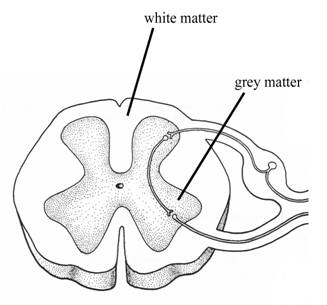
In this cross-section a spinal cord is the grey matter in the centre, in those funny shaped structures with horns and the white matter outside of the horns. (Remember white matter is formed by nerves travelling up and down your spinal cord and grey matter is formed by the cell bodies of the neurons).
 The brain and spinal cord are quite fragile. They are protected by a series of bone, membrane, and fluid. The bones are the skull that protected the brain and the vertebrae that protected the spinal cord. Then, there are three membranes called meninges. In these meniges there is a clear liquid called cerebroespinal fluid (CSF). This liquids forms a cushion between the soft brain tissue and the hard cranial bones.
In this cross-section a spinal cord is the grey matter in the centre, in those funny shaped structures with horns and the white matter outside of the horns. (Remember white matter is formed by nerves travelling up and down your spinal cord and grey matter is formed by the cell bodies of the neurons).
 The brain and spinal cord are quite fragile. They are protected by a series of bone, membrane, and fluid. The bones are the skull that protected the brain and the vertebrae that protected the spinal cord. Then, there are three membranes called meninges. In these meniges there is a clear liquid called cerebroespinal fluid (CSF). This liquids forms a cushion between the soft brain tissue and the hard cranial bones.
 lunes, 21 de marzo de 2011
60+Earth Hour
Turning off the lights on March 26 is just a step to recognize that mother earth needs our help. Together we can protect earths precious resources by conserving, developing, and spreading the word. Flipping the swtich for one hour on Saturday will be your vote for mother earth.
Earth Hour, was first started in Australia (2007) as a way to bring community together to acknowledge the importance of reducing consumption of earths natural resources. Turning off the lights for an hour helps us see the impact we have on the environment..
Just one year after the first "Earth Hour" in Sydney Australia it became a viral phenonemon. Now spreading globally with a movement reaching more than 50 million people that participate in more than 35 countries.
Earth Hour hopes to encourage consumers, businesses, and governments to be thoughtful in action plans to caryy out practical ways to reduce emmissions.
In Spain it will be next saturday from 20.30 to 21.30. Pocoyo is going to be one of the main protagonist of the third edition of the Earth Hour.
If you have more interest about the activities of this day you can go to http://www.horadelplaneta.es/
I encourage you to participate. You are the future and there is only one EARTH
Earth Hour, was first started in Australia (2007) as a way to bring community together to acknowledge the importance of reducing consumption of earths natural resources. Turning off the lights for an hour helps us see the impact we have on the environment..
Just one year after the first "Earth Hour" in Sydney Australia it became a viral phenonemon. Now spreading globally with a movement reaching more than 50 million people that participate in more than 35 countries.
Earth Hour hopes to encourage consumers, businesses, and governments to be thoughtful in action plans to caryy out practical ways to reduce emmissions.
In Spain it will be next saturday from 20.30 to 21.30. Pocoyo is going to be one of the main protagonist of the third edition of the Earth Hour.
If you have more interest about the activities of this day you can go to http://www.horadelplaneta.es/
I encourage you to participate. You are the future and there is only one EARTH
Suscribirse a:
Entradas (Atom)