Mostrando entradas con la etiqueta respiration. Mostrar todas las entradas

domingo, 16 de enero de 2011

The Journey of a Breath of Air

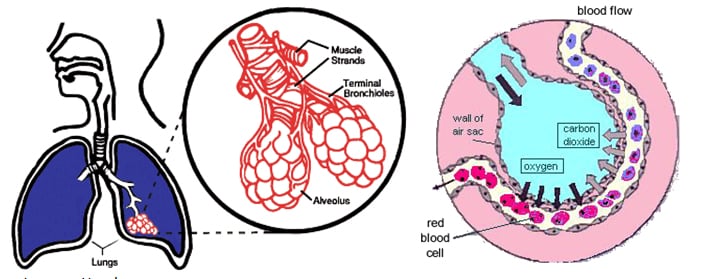
When you breath in, oxygen is drawn in through the nose or mouth and down into the lungs. The oxygen then passes across the thin lining of the capillaries and into the blood. The oxygen molecules are carried to the body cells by the blood. Carbon dioxide from the body cells is carried by the blood to the lungs where it is released into the air.
Breathing is only part of the process of delivering oxygen to where it is needed in the body. Gas exchange occurs in the alveoli by passive diffusion of gases between the alveoli and the blood in the capillaries of the lungs.


Diffusion is the movement of substances from an area of higher concentration to an area of lower concentration. The concentration of O2 in the alveoli is at a higher level than in the blood and the concentration of CO2 in the alveoli is at a lower lever than in the blood. O2 molecules diffuse across the thin walls of the alveoli and capillaries and into the blood. Carbon dioxide (CO2) moves out of the blood and into the alveoli in a similar way
The pulmonary artery carries the blood traveling to the lungs and alveoli. Upon reaching the alveoli the blood picks up the inhaled oxygen and at the same time releases the carbon dioxide that needs to be expelled. The pulmonary veins then carry the oxygenated blood to the heart to be pumped through the aorta and around the body. The oxygenated blood travels to the smaller arteries and finally to the capillaries where gas exchange occurs.
The oxygen molecules move out of the capillaries and into the body cells. It is used by the cells to Cellular respiration, the process of breaking down glucose to release energy .
C6H12O6 + 6O2 → 6H2O + 6 CO2 + ENERGY
The waste products of cellular respiration include carbon dioxide and water. The carbon dioxide molecules move out of the cells and into the capillaries that surround the cells. The carbon dioxide is removed from the body by the lungs.

sábado, 15 de enero de 2011

How we breathe

Most of the time, you breathe without thinking of it. Breathing is mostly an involuntary action that is controlled by a part of your brain that also controls your heart beat. If you swim or sing, by instance, you know you can also control your breathing.
The taking in and expelling out of air is done by two movements:Inspiration and expiration. Inspiration: breathing in (a.k.a., inhalation)
Taking air into the body through the nose and mouth. It’s always an active process
caused by muscular contraction, mainly of the diaphragm
with the help of intercostal muscles. During inhalation, the diaphragm contracts and moves downward. The rib muscles contract and cause the ribs to move outward. This causes the chest volume to increase. Because the chest volume is larger, the air pressure inside the lungs is less than the air pressure outside. This difference in air pressures causes air to be sucked into the lungs.
Expiration: breathing out (a.k.a., exhalation)
Pushing air out of the body through the nose or mouth It’s typically a passive process caused by elastic recoil of the lungs and relaxation of diaphragm and intercostal muscles. When the diaphragm and rib muscles relax, the chest volume is smaller, the air pressure inside the lungs is bigger than the air pressure outside. This difference in air pressures causes air to be pushed out of the lungs. Exhalation is similar to letting the air out of a balloon.
The lungs cannot move by themselves. As mentioned above, air moves into and out of the lungs by the movement of muscles. The diaphragm and rib muscles contract and relax to move air in to and out of the lungs.
After ventilation, the second stage of breathing is the gas exchange. It takes place in the alveoli. The walls of the alveoli are very thin and are permeable to gases. The alveoli are lined with capillaries, the walls of which are also thin enough to allow gas exchange.
Oxygen diffuses from the alveoli to the blood in the capillaries that surround the alveoli. At the same time, carbon dioxide diffuses in the opposite direction, from capillary blood to the alveoli. At this point, the pulmonary blood is oxygen-rich, and the lungs are holding carbon dioxide. Exhalation follows, thereby ridding the body of the carbon dioxide and completing the cycle of respiration.